Rice Purity Test Score Meaning: Complete Guide (2026)
If you’ve just taken the Rice Purity Test, the number you got might leave you curious what it actually says about you. You get confused by seeing whether the score is high or low. Most people are unaware of the real meaning behind those numbers.
The truth is, your score isn’t about being “good” or “bad.” It simply reflects your level of life experience based on 100 questions covering relationships, habits, and personal choices.
In this guide, you’ll learn the exact rice purity test score meaning and how it works in a simple way without any confusion.
How Does the Rice Purity Test Score Actually Work?
The test score system is simple once you understand how it works. It includes 100 questions, and you answer each one with “yes” or “no” based on your personal experiences.
Read the question carefully and if you experience something, answer it yes by ticking the box. Each “Yes” subtracts 1 point from the final score. You’ll get your score after completing the test which measures your purity level.
For example: if your score is 96 means you experience 4 things out of 100 questions in your life. This means you have minimum exposure to life experiences.
Rice Purity Test Score Chart: Full Meaning Breakdown
The score gives you a clear idea of your level of life experience. Here are the meanings of different score ranges:
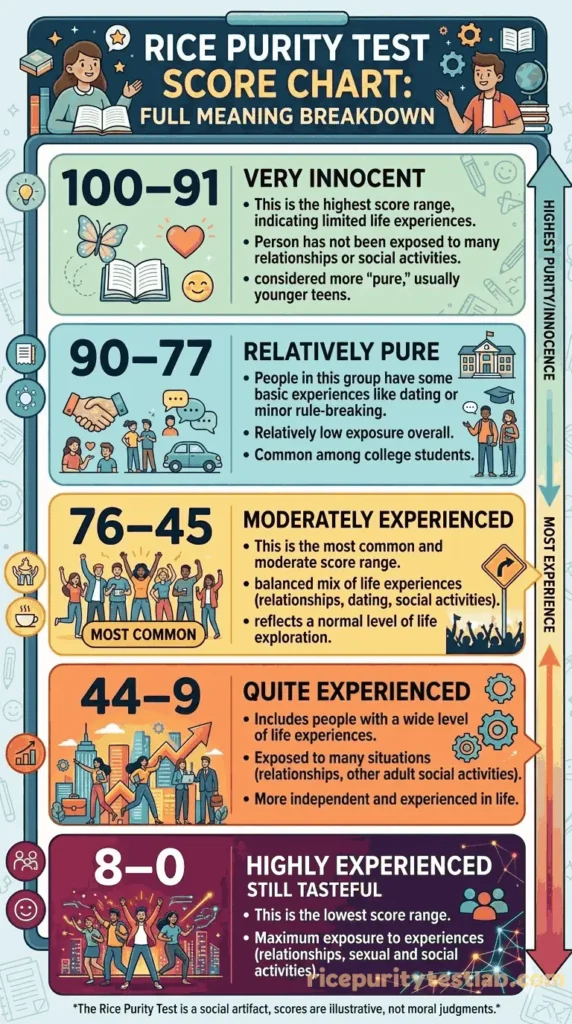
Score 100–91 – Very Innocent
This is the highest score range, which usually indicates limited life experiences. It means a person has not been exposed to many relationships or social activities listed in the test. People in this group are often considered more “pure,” and they are usually at an early stage of life, such as younger teens.
Score 90–77 – Relatively Pure
People in this group have some basic experiences like dating or minor rule-breaking, but they still have relatively low exposure overall. This range is commonly seen among college students.
Score 76–45 – Moderately Experienced
This is the most common and moderate score range. People in this group have a balanced mix of life experiences, including relationships, dating, and social activities. It simply reflects a normal level of life exploration.
Score 44–9 – Quite Experienced
This score range includes people with a wide level of life experiences. They have been exposed to many situations listed in the test, such as relationships and other adult social activities. People in this group are often seen as more independent and experienced in life.
Score 8–0 – Highly Experienced
This is the lowest score range which means the people in this group have maximum exposure to experiences like relationships, sexual and social activities.
What Is the Average Rice Purity Test Score?
The average Rice Purity Test score is around 72 among students at Rice University. However, this number can vary depending on different universities and student groups.
Overall Average Score
Most people score between 60 and 80. This range reflects a balanced level of experience, neither too limited nor too extreme.
Average Score by Age Group
Here’s a general breakdown of how scores usually vary across different age groups:
- Ages 13–16 → Score 85–100
- Ages 17–20 → Score 70–90
- Ages 21–25 → Score 50–75
- Ages 25+ → Score 40–70
As people grow older, their score naturally decreases due to more life experiences.
Note: These are general estimates, not scientific data
Is a High Score Good or a Low Score Bad?
In reality, there is no good or bad score at all.
A high score simply means you have had fewer of the experiences listed in the test, which is often linked to a youth or early stage of life.
A low score, on the other hand, means you’ve had more of those experiences and a wider range of life exposure.
The test score meaning is not meant for judgment or comparison. It’s just a fun quiz that reflects different life experiences, not your personality, value, or character.
What Is the Highest and Lowest Possible Score?
This Test uses a simple scoring system that ranges from 0 to 100.
Highest score: 100
- Means you answered “no” to everything
- Very rare unless you’re very young
Lowest score: 0
- Means you answered “yes” to all questions
- Extremely rare
Should You Retake the Rice Purity Test?
Yes, you can retake the Rice Purity Test anytime you want. There are no specific rules or limits. Many people take it again after experiencing changes in their life to see their new score. The most interesting part is that you can also compare your past and present results.